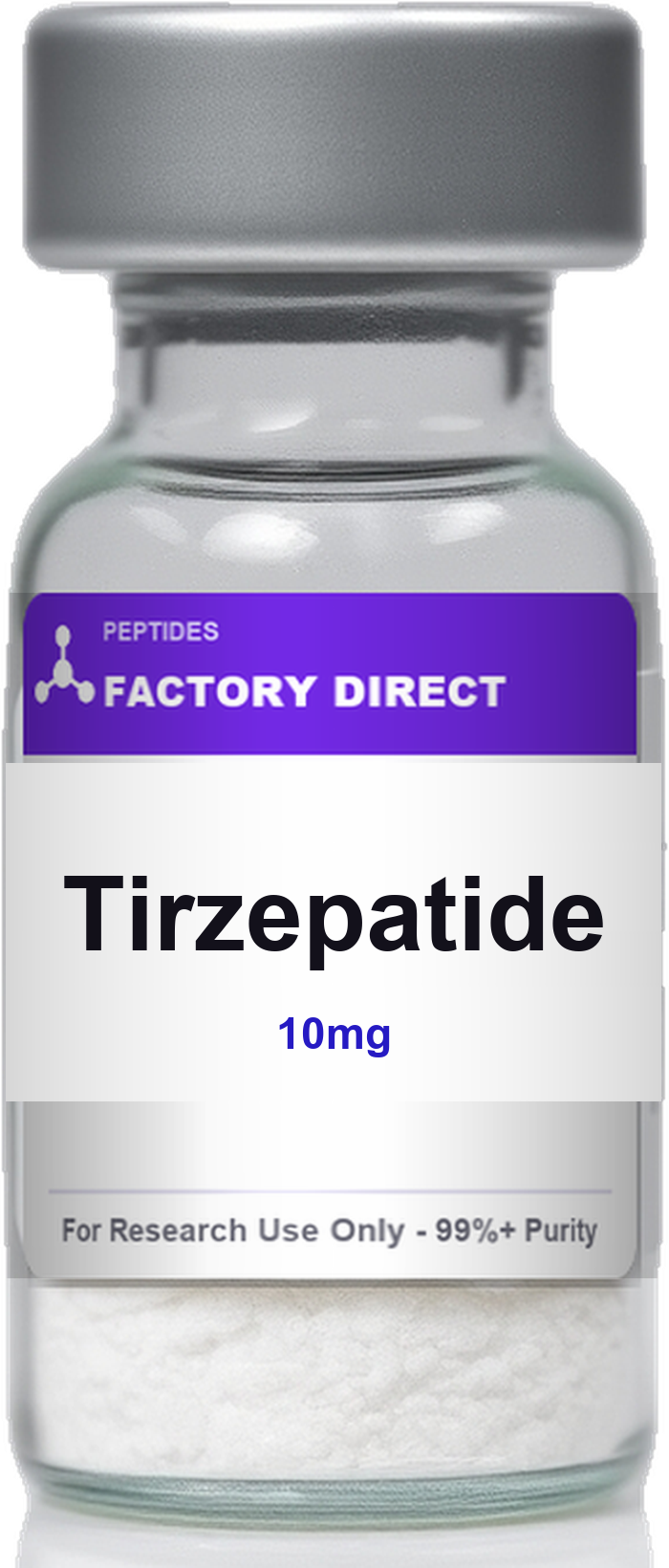
Create a free research account to view current pricing and place your order in minutes.
What is Tirzepatide?
Tirzepatide is a dual agonist that activates both GLP-1 and GIP (glucose-dependent insulinotropic polypeptide) receptors. It is one of the most-studied modern metabolic research peptides because it engages two incretin pathways at once.
How Tirzepatide works (research mechanism)
Tirzepatide research examines combined GLP-1 and GIP signaling on insulin response, satiety, and energy handling, with the dual-pathway mechanism the central research distinction.
Primary research applications
Weight-management research
Studied for body-weight endpoints via dual incretin signaling.
Glucose-metabolism research
Examined for combined GLP-1/GIP metabolic effects.
Comparative incretin studies
Frequently compared with semaglutide.
Research dosing reference
Research references describe a titration model from 2.5 mg up to 15 mg weekly over several weeks. Reference values only.
Reconstitution & handling
Tirzepatide ships as a lyophilized (freeze-dried) powder and must be reconstituted before use in any liquid research model. Allow the vial to reach room temperature, swab the stopper, then add bacteriostatic water slowly down the inside wall of the vial - never spray it directly onto the powder. Swirl gently until dissolved; do not shake, as shaking foams the solution and stresses the peptide. The volume of water you add sets the concentration: a 5 mg vial reconstituted with 2 mL yields 2,500 mcg/mL, so 0.1 mL measures 250 mcg. A correctly reconstituted Tirzepatide solution is clear; discard if it is cloudy or shows particulate.
Storage & stability
Store un-reconstituted Tirzepatide vials refrigerated and protected from light for long-term stability; the lyophilized form is robust and tolerates shipping. After reconstitution, refrigerate at 2-8C, keep away from light, and use within the typical research window of roughly two to four weeks. The benzyl alcohol in bacteriostatic water helps inhibit microbial growth across that period. Always label reconstituted vials with the concentration and date.
Common research pairings
Studied as a standalone dual-agonist model or compared with semaglutide.
How Tirzepatide compares
Tirzepatide adds GIP activity on top of GLP-1, which is the defining contrast with single-pathway semaglutide in research.
Safety & research considerations
Supplied for research use only; not for human consumption. GI effects are noted in the incretin literature.
Tirzepatide research reference data
The figures below are reference values compiled from the research literature for laboratory study design only. They are not instructions for any living subject. See the full Tirzepatide research reference for complete detail and citations.
Half-life and exposure. Approx. 5-6 days
Pharmacokinetics (research reference). Approximate half-life is 5-6 days. Median time to maximum concentration is about 24 hours with a reported range of roughly 8-72 hours; steady state is typically achieved after about 4 weeks of once-weekly administration.
Tirzepatide dose-reference table
| Reference dose | Units (U-100 syringe) |
|---|---|
| 2.5 mg | 50 units |
| 5 mg | 100 units |
| 10 mg | 200 units |
| 15 mg | 300 units |
Reconstitution and concentration by vial size
| Vial | Reconstitute with | Concentration |
|---|---|---|
| 10 mg | 2 mL BAC Water | 0.050 mg/unit |
| 20 mg | 2 mL BAC Water | 0.100 mg/unit |
| 30 mg | 3 mL BAC Water preferred for cleaner concentration interpretation | 0.100 mg/unit |
| 60 mg | 3 mL BAC Water preferred for cleaner concentration interpretation | 0.200 mg/unit |
Research timing. Once weekly on a consistent day. Time of day is less important than consistency; choose timing that minimizes nausea disruption.
Dose-escalation reference. Start at the lowest practical exposure and hold each step long enough to evaluate GI tolerance before increasing.
Monitoring in research models. Monitor nausea, reflux, constipation, reduced appetite, hydration status, fatigue, and delayed gastric emptying. Slow escalation and hydration/electrolytes are primary mitigation tools.
Reassessment cadence. Long-term metabolic protocols should include reassessment every 8-12 weeks: GI tolerance, hydration, appetite adaptation, body-composition response, metabolic markers, and whether escalation is still needed. Avoid continuous escalation without objective review.
Stacking notes (research). Avoid stacking overlapping incretin agonists unless intentionally structured and clinician supervised. Pathway contrast with GH-axis, mitochondrial, or lipolysis adjuncts is generally cleaner than incretin overlap.
Sourcing, purity & Certificate of Analysis
Every lot of Tirzepatide sold by Peptides Factory Direct is third-party tested to a 99%+ purity target, with identity confirmed by mass spectrometry and purity quantified by HPLC. A Certificate of Analysis (COA) documenting these results is available on request and ties each vial to a tracked lot. Material ships nationwide to all 50 US states with cold-chain handling where appropriate and fast domestic dispatch. This documentation is what separates research-grade Tirzepatide from unverified material - quality is established before the vial ever reaches your lab.
Buy Tirzepatide for research
Available research sizes:
How to order Tirzepatide for research
Tirzepatide can be ordered through the Peptides Factory Direct research portal as a one-time purchase or on a recurring research schedule (every 2 weeks, monthly, every 2 months, or every 3 months). Checkout requires confirming you are 21 or older, purchasing for laboratory research only, and that the product is not for human or animal consumption. Bulk and standing-order pricing is available - note it in your order. Open the order portal to view current research sizes and pricing.
Frequently asked questions
What makes tirzepatide different?
It is a dual GLP-1/GIP agonist - it engages two incretin pathways, unlike single-pathway semaglutide. Research use only.
What sizes are available?
10 mg, 20 mg, and 40 mg vials, third-party tested, COA on request.
Is tirzepatide for human use?
No - it is supplied strictly for laboratory research.
Researcher reviews
No reviews yet. If you have researched Tirzepatide, be the first to leave a review.
Write a review
Related Fat Loss & Weight Management peptides
Tirzepatide cost & pricing · Compare peptides · All Fat Loss & Weight Management peptides · Research guides · Choosing a supplier
External references: Peptides (Wikipedia) · U.S. Food and Drug Administration