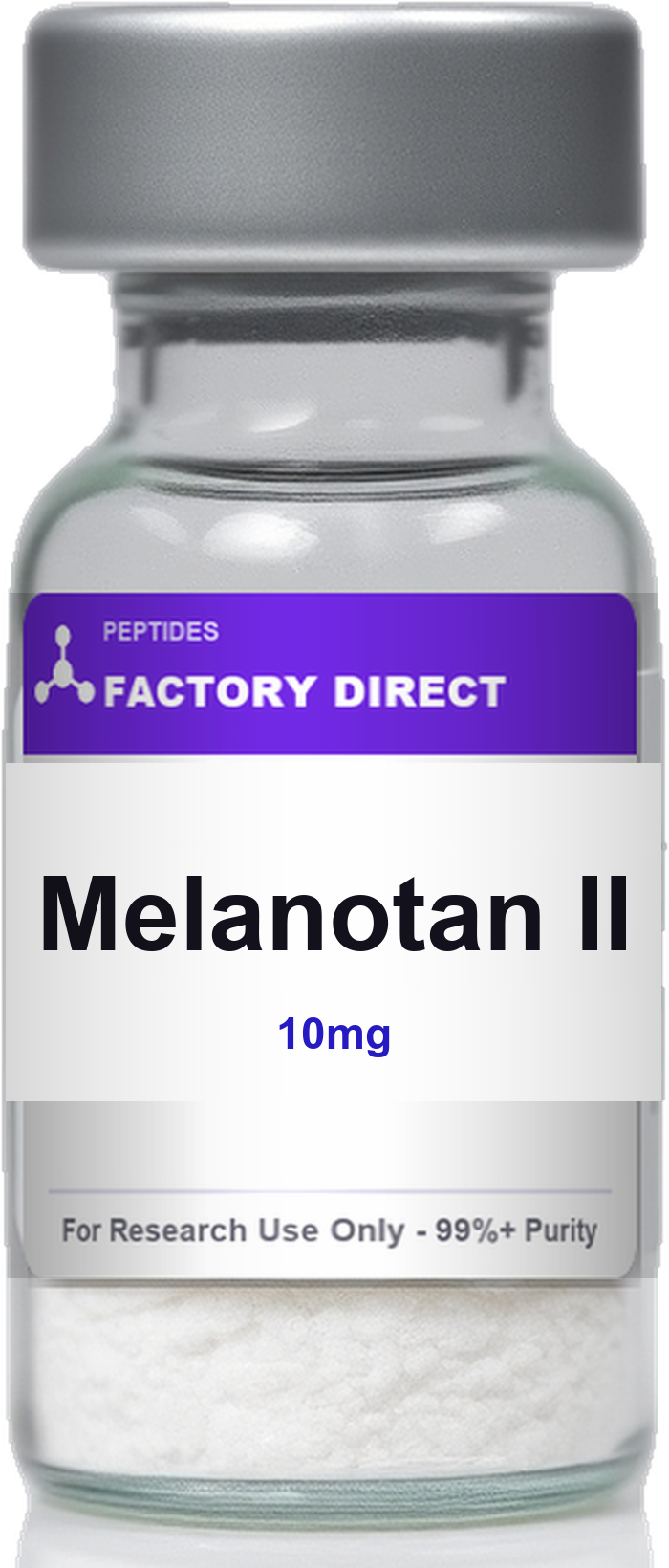
Create a free research account to view current pricing and place your order in minutes.
What is Melanotan II?
Melanotan II is a synthetic analog of alpha-melanocyte-stimulating hormone, a non-selective melanocortin agonist. It is studied for melanogenesis (pigmentation) and broader melanocortin endpoints in research models.
How Melanotan II works (research mechanism)
Melanotan II activates multiple melanocortin receptors, driving melanin production in research models and engaging MC4R pathways relevant to appetite and libido endpoints.
Primary research applications
Pigmentation research
Studied for melanogenesis and tanning endpoints in models.
Melanocortin-pathway research
A broad melanocortin agonist for receptor studies.
Appetite/libido signaling research
Examined for MC4R-mediated endpoints.
Research dosing reference
Research references commonly cite 0.5-1 mg two to three times weekly. Reference values only.
Reconstitution & handling
Melanotan II ships as a lyophilized (freeze-dried) powder and must be reconstituted before use in any liquid research model. Allow the vial to reach room temperature, swab the stopper, then add bacteriostatic water slowly down the inside wall of the vial - never spray it directly onto the powder. Swirl gently until dissolved; do not shake, as shaking foams the solution and stresses the peptide. The volume of water you add sets the concentration: a 5 mg vial reconstituted with 2 mL yields 2,500 mcg/mL, so 0.1 mL measures 250 mcg. A correctly reconstituted Melanotan II solution is clear; discard if it is cloudy or shows particulate.
Storage & stability
Store un-reconstituted Melanotan II vials refrigerated and protected from light for long-term stability; the lyophilized form is robust and tolerates shipping. After reconstitution, refrigerate at 2-8C, keep away from light, and use within the typical research window of roughly two to four weeks. The benzyl alcohol in bacteriostatic water helps inhibit microbial growth across that period. Always label reconstituted vials with the concentration and date.
Common research pairings
Generally studied as a standalone melanocortin agonist.
How Melanotan II compares
Melanotan II is a non-selective agonist studied for pigmentation and broad melanocortin endpoints; Melanotan I (afamelanotide) is more selective; PT-141 is studied for sexual function.
Safety & research considerations
Melanotan II is a research chemical not approved for human use; the literature notes nausea and lasting pigmentation in models. For laboratory research only.
Melanotan II research reference data
The figures below are reference values compiled from the research literature for laboratory study design only. They are not instructions for any living subject. See the full Melanotan II research reference for complete detail and citations.
Half-life and exposure. Short-to-moderate; context dependent
Pharmacokinetics (research reference). Human pharmacokinetics are not standardized. Treat exposure as short acting unless compound-specific data or formal formulation labeling indicates otherwise.
Melanotan II dose-reference table
| Reference dose | Units (U-100 syringe) |
|---|---|
| 250 mcg | 5 units |
| 500 mcg | 10 units |
| 1 mg | 20 units |
Reconstitution and concentration by vial size
| Vial | Reconstitute with | Concentration |
|---|---|---|
| 10 mg | 2 mL BAC Water | 0.050 mg/unit |
Research timing. Often administered evening or consistent daily/EOD; UV exposure variables must be controlled in pigmentation research.
Dose-escalation reference. Begin very low due to nausea, flushing, libido, and pigmentation response variability.
Monitoring in research models. Monitor nausea, flushing, appetite changes, libido changes, mole/pigment changes, and blood pressure response.
Reassessment cadence. Use short pigment-response blocks with regular skin/mole monitoring and off-intervals. Avoid indefinite use without dermatologic and tolerance review. Appendices Appendix A - GLP / Metabolic Pathway Primer GLP-1 is an incretin hormone released primarily from intestinal L-cells after nutrient exposure. GLP-1 receptor signaling enhances glucose-dependent insulin secretion, suppresses glucagon release, slows gastric emptying, and activates hypothalamic/brainstem satiety pathways. GIP is another incretin hormone that supports glucose-dependent insulin secretion and may influence adipocyte nutrient partitioning. Glucagon receptor agonism differs from GLP-only signaling: it may increase hepatic fatty-acid utilization and energy expenditure, which is why triple agonists are mechanistically distinct from standard GLP-1 agonists. Metabolic improvements seen with incretin-pathway compounds often reflect multiple overlapping mechanisms: reduced caloric intake, improved glycemic control, changes in hepatic glucose output, lower triglyceride flux, reduced ectopic fat burden, and secondary improvements in inflammatory markers. Appendix B - Protocol Duration Logic Protocol duration depends on use case. Acute repair protocols are usually short and objective-driven. Maintenance protocols are lower-frequency and reassessed periodically. Metabolic modulation may be long-term but still requires scheduled review. High-caution investigational compounds should not be repeated casually. Suggested reassessment categories: - Acute injury or repair: reassess 2-6 weeks. - Metabolic modulation: reassess 8-12 weeks. - GH-axis protocols: reassess 8-12 weeks with IGF-1/glucose context where appropriate. - Mitochondrial support: reassess 4-12 weeks. - Bioregulator pulses: reassess after 10-30 days and allow off-intervals. - High-caution investigational agents: extended reassessment intervals and clinician review strongly preferred. Appendix C - GH Axis Pathway Primer The GH axis is driven by hypothalamic-pituitary signaling. GHRH analogs stimulate pituitary GHRH receptors to promote endogenous GH pulses. GHSR/ghrelin receptor agonists can amplify GH secretory pulses but may also affect hunger, water retention, and glucose handling. Downstream IGF-1 signaling is biologically meaningful but requires monitoring because excessive GH-axis stacking can increase edema, tingling, glucose variability, and carpal-tunnel-like symptoms. Appendix D - Reconstitution Mathematics U-100 insulin syringes measure volume, not dose. On a U-100 syringe, 100 units equals 1.00 mL and 1 unit equals 0.01 mL. Dose per unit is calculated as total vial content divided by total units after reconstitution. Examples: 10 mg + 2 mL = 10 mg / 200 units = 0.050 mg/unit. 20 mg + 2 mL = 20 mg / 200 units = 0.100 mg/unit. 30 mg + 3 mL = 30 mg / 300 units = 0.100 mg/unit. 60 mg + 3 mL = 60 mg / 300 units = 0.200 mg/unit. This is why 20 units is not a dose by itself. 20 units of a 10 mg vial reconstituted with 2 mL equals 1 mg, while 20 units of a 60 mg vial reconstituted with 3 mL equals 4 mg. Appendix E - BAC Water vs AA Water vs Saline Bacteriostatic water contains benzyl alcohol and is commonly used for multi-dose peptide reconstitution when compatible with the compound. Sterile saline may improve comfort in some contexts but does not provide the same antimicrobial preservation. Acetic acid solution may improve stability or solubility for certain peptides, especially some IGF-style or difficult-to-solubilize compounds. DMSO or specialty solvents may be required for some formulation-sensitive compounds, but should never be assumed compatible without formulation review. Solvent selection affects stability, comfort, sterility, and concentration behavior. Copper-containing or high-content peptides often benefit from larger reconstitution volumes to improve dissolution and reduce injection discomfort. Appendix F - Storage, Stability, and Degradation Peptides can degrade through heat exposure, UV/light exposure, oxidation, hydrolysis, microbial contamination, repeated freeze/thaw cycles, and excessive agitation. Best practices include refrigerated storage after reconstitution, minimizing light and temperature cycling, gentle reconstitution instead of shaking, sterile handling, and avoiding repeated puncture beyond reasonable multi-dose handling windows. Lyophilized products are generally more stable than reconstituted products, but exact stability depends on peptide sequence, excipients, solvent, pH, and sterility conditions. Appendix G - Common Operational Mistakes Common mistakes include confusing units with milligrams, using protocols without knowing vial concentration, assuming a 20 mg vial and 60 mg vial dose the same at equal syringe marks, escalating too quickly, stacking overlapping incretin agonists, failing to hydrate during appetite-suppressive protocols, using the wrong solvent, shaking fragile peptides, and treating research-only compounds as standardized clinical products. The operating philosophy of this compendium is conservative: one change at a time, known concentration, clear objective, documented response, and escalation only when tolerated. Selected References and Evidence Notes 1. FDA Prescribing Information: Ozempic/Wegovy (semaglutide) - GLP-1 mechanism, half-life, Tmax, steady-state behavior. 2. FDA Prescribing Information: Mounjaro/Zepbound (tirzepatide) - GLP/GIP mechanism, pharmacokinetics, half-life, Tmax, and steady-state behavior. 3. FDA Prescribing Information: Egrifta/Egrifta WR (tesamorelin) - GHRH analog pharmacology, IGF-1 monitoring, and metabolic safety considerations. 4. FDA Prescribing Information: Vyleesi (bremelanotide/PT-141 analog) - melanocortin receptor agonism, Tmax, and terminal half-life. 5. BPC-157 literature: angiogenesis, nitric oxide signaling, VEGFR/Akt-eNOS pathway discussion, and tissue-repair research. 6. Thymosin beta-4 literature: actin-binding biology, angiogenesis, wound healing, and tissue repair. 7. Pickart et al. and related GHK-Cu reviews: copper peptide signaling, collagen remodeling, antioxidant response, and skin/wound repair. 8. KPV/alpha-MSH-derived peptide literature: anti-inflammatory signaling and NF-kB-related pathway modulation. 9. MOTS-C literature: mitochondrial-derived peptide biology, AMPK-linked metabolic homeostasis, and insulin-sensitivity research. 10. SS-31/elamipretide literature: cardiolipin interaction, mitochondrial membrane stabilization, and oxidative-stress modulation. 11. LL-37 literature: host-defense peptide biology, antimicrobial activity, wound vascularization, and immunomodulation. 12. Thymosin Alpha-1 literature: thymic immune modulation, T-cell signaling, dendritic-cell activity, and immune homeostasis. 13. For research-only compounds with limited human pharmacokinetic standardization, entries use conservative language and identify uncertainty rather than overstating clinical certainty.
Stacking notes (research). Avoid stacking with PT-141 or other melanocortin agents without careful dose separation and monitoring.
Sourcing, purity & Certificate of Analysis
Every lot of Melanotan II sold by Peptides Factory Direct is third-party tested to a 99%+ purity target, with identity confirmed by mass spectrometry and purity quantified by HPLC. A Certificate of Analysis (COA) documenting these results is available on request and ties each vial to a tracked lot. Material ships nationwide to all 50 US states with cold-chain handling where appropriate and fast domestic dispatch. This documentation is what separates research-grade Melanotan II from unverified material - quality is established before the vial ever reaches your lab.
How to order Melanotan II for research
Melanotan II can be ordered through the Peptides Factory Direct research portal as a one-time purchase or on a recurring research schedule (every 2 weeks, monthly, every 2 months, or every 3 months). Checkout requires confirming you are 21 or older, purchasing for laboratory research only, and that the product is not for human or animal consumption. Bulk and standing-order pricing is available - note it in your order. Open the order portal to view current research sizes and pricing.
Frequently asked questions
What is Melanotan II researched for?
Melanogenesis/pigmentation and broad melanocortin-receptor endpoints. Research use only - not for human consumption.
What size is stocked?
10 mg vial, third-party tested, COA on request.
Is Melanotan II FDA approved?
No, it is a research chemical, not for human consumption.
Researcher reviews
No reviews yet. If you have researched Melanotan II, be the first to leave a review.
Write a review
Related Sexual Health & Tanning peptides
Melanotan II cost & pricing · Compare peptides · All Sexual Health & Tanning peptides · Research guides · Choosing a supplier
External references: Peptides (Wikipedia) · U.S. Food and Drug Administration