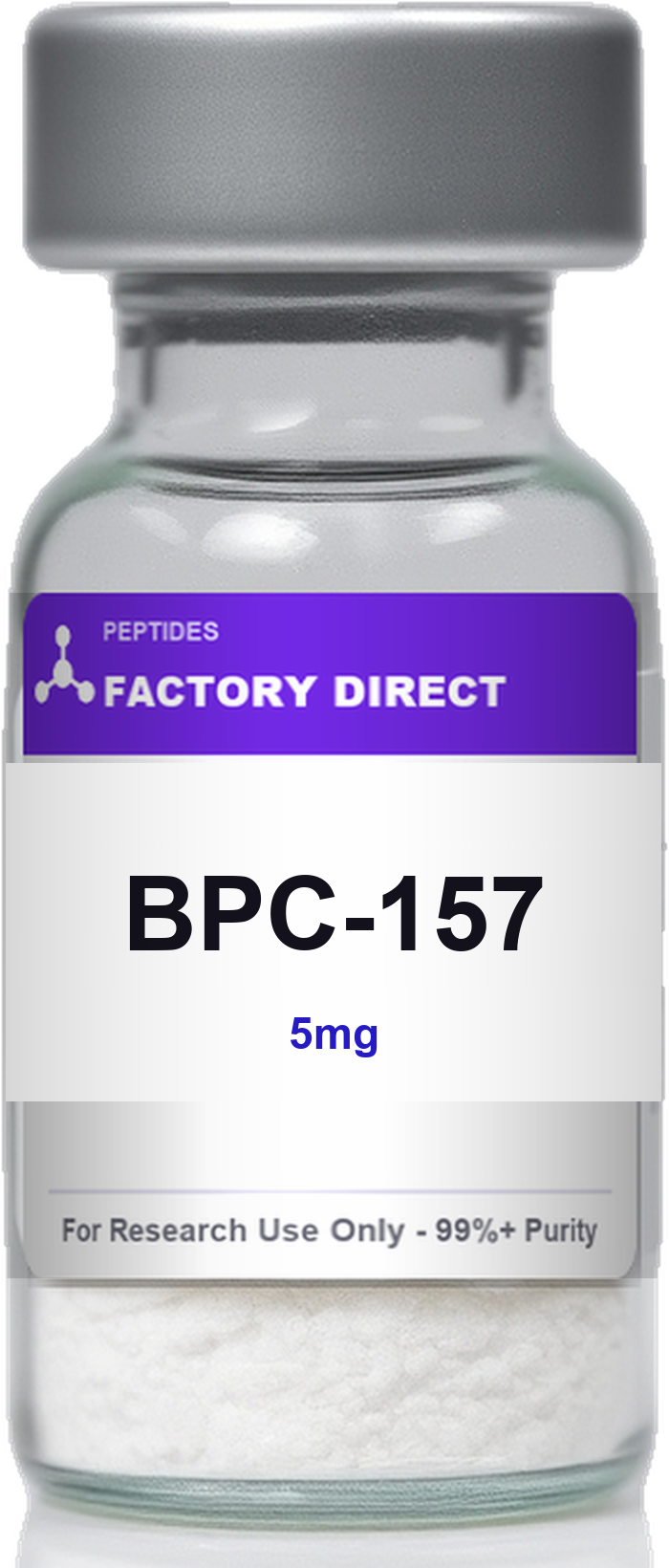
Create a free research account to view current pricing and place your order in minutes.
What is BPC-157?
BPC-157 (Body Protection Compound 157) is a synthetic, stable pentadecapeptide of 15 amino acids derived from a partial sequence of a protein found in human gastric juice. In the research literature it is one of the most frequently studied "body protection" peptides because of its stability in gastric and aqueous environments and its broad activity across connective and epithelial tissue models.
How BPC-157 works (research mechanism)
Research models associate BPC-157 with up-regulation of growth-factor signaling (notably the VEGFR2 pathway and FAK-paxillin signaling) that supports angiogenesis - the formation of new blood vessels - in injured tissue. It is also studied for modulation of the nitric-oxide system and for interaction with the gut-brain axis. These mechanisms are the subject of ongoing pre-clinical investigation and are reported in animal and in-vitro studies, not approved clinical indications.
Primary research applications
Tendon and ligament repair research
A large share of BPC-157 literature examines tendon-to-bone healing, ligament models, and the tensile recovery of connective tissue after controlled injury. Researchers study it both locally (near a modeled injury site) and systemically because of its reported stability.
Gastrointestinal models
Because the parent sequence originates in gastric juice, BPC-157 is heavily studied in models of gut-lining integrity, ulceration, and inflammatory bowel conditions, where angiogenesis and epithelial repair are the variables of interest.
Inflammation and joint research
Anti-inflammatory signaling and joint-tissue models are a third common research theme, frequently paired with TB-500 in comparative stacking studies.
Research dosing reference
Research-reference protocols in the literature commonly cite 250-500 mcg once or twice daily over a 4-12 week study window, with some maintenance models at 250 mcg daily. These figures are reference values from published research only and are not dosing instructions for any living subject.
Reconstitution & handling
BPC-157 ships as a lyophilized (freeze-dried) powder and must be reconstituted before use in any liquid research model. Allow the vial to reach room temperature, swab the stopper, then add bacteriostatic water slowly down the inside wall of the vial - never spray it directly onto the powder. Swirl gently until dissolved; do not shake, as shaking foams the solution and stresses the peptide. The volume of water you add sets the concentration: a 5 mg vial reconstituted with 2 mL yields 2,500 mcg/mL, so 0.1 mL measures 250 mcg. A correctly reconstituted BPC-157 solution is clear; discard if it is cloudy or shows particulate.
Storage & stability
Store un-reconstituted BPC-157 vials refrigerated and protected from light for long-term stability; the lyophilized form is robust and tolerates shipping. After reconstitution, refrigerate at 2-8C, keep away from light, and use within the typical research window of roughly two to four weeks. The benzyl alcohol in bacteriostatic water helps inhibit microbial growth across that period. Always label reconstituted vials with the concentration and date.
Common research pairings
In the literature BPC-157 is most often studied alongside TB-500 (Thymosin Beta-4) for connective-tissue work, since the two are reported to act through complementary repair pathways - BPC-157 more locally and TB-500 through deeper, slower regeneration.
How BPC-157 compares
Compared with TB-500, BPC-157 is studied as a faster-acting, more localized repair peptide; compared with GHK-Cu it targets connective and gut tissue rather than skin and hair. It is one of the most stability-tested peptides in the research catalog.
Safety & research considerations
BPC-157 is classified as a research chemical and is not approved by the FDA for human use. It carries no recognized clinical safety profile because it has not completed human trials. All handling is for in-vitro and laboratory research only.
BPC-157 research reference data
The figures below are reference values compiled from the research literature for laboratory study design only. They are not instructions for any living subject. See the full BPC-157 research reference for complete detail and citations.
Half-life and exposure. Short acting; human PK limited
Pharmacokinetics (research reference). Human PK is limited. Operationally treated as short acting; once or twice daily protocols are commonly used to preserve tissue-repair signaling windows.
BPC-157 dose-reference table
| Reference dose | Units (U-100 syringe) |
|---|---|
| 250 mcg | 5 units |
| 500 mcg | 10 units |
| 1.0 mg | 20 units |
Reconstitution and concentration by vial size
| Vial | Reconstitute with | Concentration |
|---|---|---|
| 10 mg | 2 mL BAC Water | 0.050 mg/unit |
| 20 mg | 2 mL BAC Water | 0.100 mg/unit |
Research timing. Daily or split AM/PM depending on protocol objective. Local versus systemic placement should be determined by research design and clinician preference.
Dose-escalation reference. Start with conservative exposure to evaluate injection-site tolerance and systemic response before increasing or layering additional repair agents.
Monitoring in research models. Monitor injection irritation, transient fatigue, headache, flushing, or unexpected inflammatory response. Rotate sites and preserve sterile technique.
Reassessment cadence. Acute repair protocols are commonly structured as 2-6 week focused blocks, then reassess pain, mobility, inflammatory response, and tissue objective. Maintenance, if used, should be lower-frequency and objective-driven.
Stacking notes (research). Commonly paired with complementary repair pathways such as BPC-157, TB-500, GHK-Cu, KPV, or SS-31 depending on tissue target.
Sourcing, purity & Certificate of Analysis
Every lot of BPC-157 sold by Peptides Factory Direct is third-party tested to a 99%+ purity target, with identity confirmed by mass spectrometry and purity quantified by HPLC. A Certificate of Analysis (COA) documenting these results is available on request and ties each vial to a tracked lot. Material ships nationwide to all 50 US states with cold-chain handling where appropriate and fast domestic dispatch. This documentation is what separates research-grade BPC-157 from unverified material - quality is established before the vial ever reaches your lab.
How to order BPC-157 for research
BPC-157 can be ordered through the Peptides Factory Direct research portal as a one-time purchase or on a recurring research schedule (every 2 weeks, monthly, every 2 months, or every 3 months). Checkout requires confirming you are 21 or older, purchasing for laboratory research only, and that the product is not for human or animal consumption. Bulk and standing-order pricing is available - note it in your order. Open the order portal to view current research sizes and pricing.
Frequently asked questions
What is BPC-157 used for in research?
It is studied for tendon, ligament, muscle, and gastrointestinal tissue-repair models, and for angiogenesis and anti-inflammatory signaling. It is for research use only and not for human consumption.
What sizes does Peptides Factory Direct stock?
BPC-157 is available as 5 mg and 10 mg lyophilized vials, third-party tested with a Certificate of Analysis available on request.
BPC-157 vs TB-500 - which is studied for what?
BPC-157 is researched for faster, localized repair and gut models; TB-500 for deeper, slower whole-body tissue regeneration. They are frequently studied together.
Is BPC-157 FDA approved?
No. BPC-157 is a research chemical, is not FDA approved, and is not for human or animal consumption.
How is BPC-157 shipped and stored?
It ships as a lyophilized powder nationwide; store refrigerated and protected from light, and refrigerate after reconstitution for research handling.
Do you provide a COA for BPC-157?
Yes - a Certificate of Analysis documenting identity and purity (99%+ target) is available on request.
Researcher reviews
No reviews yet. If you have researched BPC-157, be the first to leave a review.
Write a review
Related Healing & Recovery peptides
BPC-157 cost & pricing · Compare peptides · All Healing & Recovery peptides · Research guides · Choosing a supplier
External references: Peptides (Wikipedia) · U.S. Food and Drug Administration